
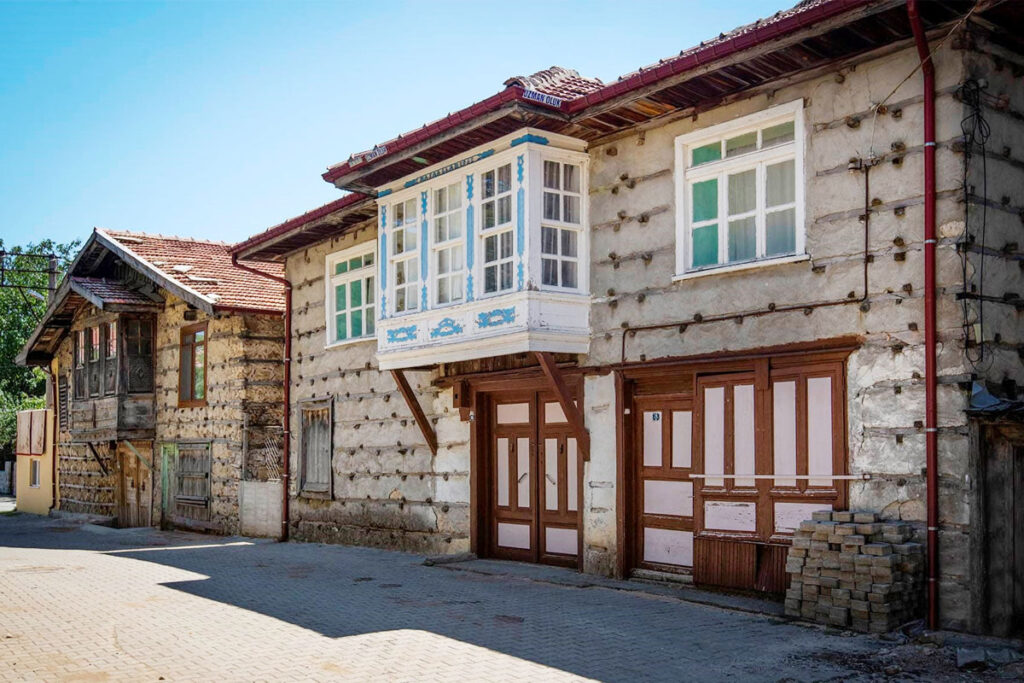
High in the Taurus Mountains, roughly three hours from the coast, sits a village that was never supposed to still be standing. Ormana, in Antalya’s İbradı district, is built almost entirely from stone houses that use no mortar, no cement and no glue of any kind — just interlocking blocks and timber, engineered centuries ago to flex rather than crack. Locals call them düğmeli evler, or “buttoned houses,” and in 2024 UN Tourism named Ormana one of the world’s Best Tourism Villages for keeping that architecture, and the way of life around it, genuinely alive rather than turning it into a museum piece.
This isn’t a polished open-air heritage park. It’s a working mountain village with 300-year-old houses people still live in, a Thursday market, a silk-weaving tradition older than the Ottoman archives that document it, and an ancient city buried directly underneath the modern bazaar. Here’s how the buttoned houses actually work, what else is worth seeing in and around Ormana, and how to plan the trip in 2026.
🏡 Explore Ormana &
Altınbeşik Cave
A full-day guided excursion into the Taurus Mountains: the buttoned houses of Ormana and a boat trip across Turkey’s largest underground lake.
✅ Free cancellation up to 24 hours before · ✅ Reserve now, pay later
Check Price & Availability →What Is Ormana?
Ormana sits around 170 km from Antalya city, tucked into the Toros (Taurus) Mountains under the İbradı district — a very different Antalya than the one on the postcards, with pine forest, mountain air and a working agricultural calendar instead of beach clubs. More than 300 of its historic buttoned houses are still standing, many of them lived in, some open for visitors to walk through. In 2024, UN Tourism selected Ormana as one of its Best Tourism Villages worldwide, recognising it for preserving both the architecture and the community that built it — not just restoring facades for tourists to photograph.
The Engineering of the Buttoned Houses
The technique, developed by Greek master builders who once worked this region, uses no mortar, cement or plaster of any kind. Walls are built by stacking local stone, but stone stacked on its own isn’t structurally stable — so builders threaded cedar timber horizontally and vertically through the stonework in a deliberate, interlocking pattern. Where those wooden beams poke out through the stone face, forming small round ends along the wall, the house gets its name: like a shirt button pulling two separate pieces of fabric into one connected whole, the timber locks the stone courses together on both axes so the entire wall behaves as a single structure, with the building’s full load carried by the wood.
That absence of rigid mortar turns out to be the real engineering trick. Without cement locking every joint solid, the wall has just enough give to flex and absorb movement during an earthquake instead of shattering — which is a large part of why houses built this way 250 to 300 years ago are still standing today. The walls are also thick and the windows small, a design that doubled as both insulation (cool in summer, warm in winter, heated by wood stove) and security for households that lived a more inward-facing, self-contained life.
📍 Local Note: Spend a night in one of the restored buttoned houses if you can. Locals say the cedar was used so densely in construction that, even after 250-plus years, the wood scent is still noticeable throughout the house.
Why Cedar?
The choice of material was practical rather than decorative. Villagers building in a remote mountain landscape worked with what the terrain actually offered, and around Ormana that meant two things: stone and timber. Local builders reached for what the region calls katran — cedar — because it grew locally, was durable, and was dense enough to lock a heavy stone wall together for centuries.
The Weaving Rooms Hidden in the Walls
One of the more surprising details of the buttoned houses sits just beneath the buttons themselves: small, enclosed chambers built into the structure. Traditionally, these weren’t storage space — they were workshops. Grandmothers set up hand looms in these sheltered little rooms and, working with wool, cotton and silk they’d spun themselves, wove scarves, clothing, curtains and rugs entirely by hand. The rooms functioned as private studios for a craft tradition that’s still being taught today.
🧵 See the Buttoned
Houses in Person
Guided day trips into Ormana and the surrounding Taurus villages, with lunch and Altınbeşik Cave included.
✅ Free cancellation up to 24 hours before · ✅ Reserve now, pay later
See Ormana Tour Options →Erimna: The Ancient City Beneath the Village
Ormana’s history runs far deeper than its 300-year-old houses. The village sits directly on top of Erimna, a Hellenistic-era city founded by Greek settlers roughly 3,000 years ago. Erimna was one of three major settlements in the area alongside Etenna and Kotenna, and by most accounts it served as the leading city of the three. The spot used as Ormana’s bazaar today was the ancient city’s marketplace as well — in antiquity, sources describe it as a busy commercial quarter lined with jewellers’ shops.
That continuous layering of history came with a cost. Because so much of the old quarter was built from timber as well as stone, a series of major fires that swept through parts of the village in the 1910s spread quickly and destroyed a significant portion of its historic wooden neighbourhoods — a reminder of how fragile even the most resilient traditional architecture can be against fire, whatever it can withstand from an earthquake.
Village Life Today
Ormana is still a working village, not a stage set. Many households keep goats, chickens and small livestock in their gardens, largely self-sufficient in the way mountain communities have always had to be. A local market sets up every Thursday, and life has visibly modernised in small but meaningful ways: women traditionally didn’t pass through the village’s central bazaar, and shops were tucked into side streets instead — a pattern that has since changed, symbolised by the village’s first female entrepreneur, who converted the old historic communal bakery into a café.
Not everything about mountain life here is postcard-perfect: residents have relied on water trucked in from outside the village for the past six years even to brew the tea Ormana is well known for locally — a practical reminder that a UN-recognised tourism village is still, first, a community managing real infrastructure challenges.
📍 Local Note: Come on a Thursday if your schedule allows it — the weekly market is when the village is at its most active, and it’s the easiest way to see daily Ormana life rather than just its architecture.
Traditional Crafts: 300 Years of Weaving
Ormana’s textile tradition goes back roughly 300 years and is still taught today at the local Public Education Centre, upstairs in the village’s old school building. The signature craft is Glamık (Gılamık) weaving — an especially fine, delicate fabric hand-woven from raw silk, traditionally worn by women as a headscarf. Grandmothers spin their own wool, cotton and silk thread on hand looms to produce scarves, garments, curtains and wall hangings from it.
Alongside Glamık, the village keeps several other handwoven traditions alive: üç etek, a traditional women’s garment made entirely from natural, hand-spun thread; kıl örtü, hand-loomed goat-hair covers with a history of around 300 years; and kıl çadır, traditional goat-hair tents woven using the same technique. Sources don’t mention other craft traditions in the village beyond textiles — pottery or metalwork don’t appear to be part of Ormana’s active craft economy today, though old farm tools are still displayed outside some village houses as a nod to that history.
The Grape Harvest Festival
Every August, Ormana holds its Grape Harvest Festival (Bağ Bozumu Şenlikleri) — in 2026, the event marks its 59th year running. A large fairground goes up in the village for the occasion, with stalls given to locals selling their own produce. Growers bring in their harvested grapes, which are numbered and judged, and the grower with the best crop wins a prize as encouragement for the year’s work.
The grapes themselves aren’t turned into wine at the festival — villagers take them home afterward and press them in traditional basins called şarakmana. The pressed juice is then boiled down in large pans, traditionally sweetened not with sugar but with pilit: the ash of oak wood, a technique passed down through generations rather than found in any recipe book.
Altınbeşik Cave: Turkey’s Largest Underground Lake
Roughly 7–8 km from Ormana sits Altınbeşik Cave, home to the largest underground lake in Turkey and a natural pairing with a village visit — most day tours combine the two. A short guided boat trip, around 15 minutes, takes visitors across the lake inside the cave.
| Altınbeşik Cave | 2026 Details |
|---|---|
| Vehicle entrance fee | 225 TL |
| Guided boat trip (per person) | 350 TL |
| Opening hours | Daily, 09:30–16:30 |
| MüzeKart | Not valid |
Access involves a final 4.5 km stretch that’s narrow, steep and winds through the mountains, and the lake’s water level depends on rainfall — the site can close temporarily after heavy rain, so it’s worth checking conditions before you set out, or simply booking a guided tour and letting someone else handle the drive and the logistics.
Getting to Ormana & Practical Tips
Ormana is around 170 km from Antalya city and roughly 117 km from the coast to nearby Altınbeşik Cave, reached via the Akseki road or the mountain route through Avasun. It’s a genuine mountain drive rather than a coastal hop — similar in spirit to the winding road up to Sapadere Canyon near Alanya, just considerably longer. On the way, it’s worth building in time for the Eynif Plain, a roughly 90,000-dönüm highland pasture along old caravan routes that’s still home to herds of semi-wild horses.
- Self-drive or guided tour: The mountain roads are manageable by car but long and winding — a guided day trip from Side, Antalya or Alanya removes the driving and usually bundles in Altınbeşik Cave and lunch.
- Allow a full day: Between the drive, the village itself and Altınbeşik Cave, this isn’t a quick stop — budget 7 to 8 hours if you’re coming from the coast.
- Bring cash: Small village shops, market stalls and craft purchases are easier with cash on hand.
- Time it for Thursday if you want to see the weekly market, or for August if the Grape Harvest Festival timing works with your trip.
- Check the weather before visiting Altınbeşik Cave: heavy rain can raise the underground lake and close the site temporarily.
Frequently Asked Questions
What are Ormana’s “buttoned houses”?
Traditional stone houses built without mortar or cement, held together by cedar timber threaded through the stonework — the protruding wooden ends give the style its name.
Why don’t the buttoned houses collapse in earthquakes?
Without rigid mortar, the stone-and-timber walls have enough flexibility to absorb tremors instead of cracking, which is a major reason many are still standing after 250–300 years.
How far is Ormana from Antalya?
About 170 km, reached via the Akseki road or the mountain route through Avasun — plan on a full-day trip if you’re coming from the coast.
Can Altınbeşik Cave be visited on the same day as Ormana?
Yes — the cave is only 7–8 km from the village, and most guided day trips combine both in one itinerary.
What is Ormana known for besides its architecture?
Its 300-year-old Glamık silk-weaving tradition, the ancient city of Erimna beneath the village, and its annual Grape Harvest Festival every August.
Final Thoughts
Ormana rewards the long drive precisely because nothing about it has been simplified for visitors — the buttoned houses are still standing because they work, the weaving rooms are still occasionally in use, and the market still runs on Thursdays whether or not a tour bus shows up. Pair it with Altınbeşik Cave and the Eynif Plain and you’ve got one of the more genuinely different days out on the Antalya coast.
🎒 Ready to Visit
Ormana?
Compare guided day trips to Ormana’s buttoned houses and Altınbeşik Cave, with easy online booking.
✅ Free cancellation up to 24 hours before · ✅ Reserve now, pay later
Book Your Ormana Day Trip →🌴 More Ancient Sites & Day Trips
Sapadere Canyon Guide · Patara Ancient City Guide · Antalya’s Roman & Ottoman Heritage · All Activities
Page last updated: August 2026.
🚗 Need a Private Transfer or Luxury Vehicle in Antalya?
We arrange private airport transfers, intercity transfers and luxury vehicle hire across the Antalya region. Message us on WhatsApp for a quick quote.
💬 WhatsApp +90 533 653 02 90