
Some stretches of the Turkish coast are made for a quick photo stop. Kaş and Patara are made for slowing down. Spend a spring weekend moving between the two — an afternoon lost in Kaş’s bougainvillea-covered lanes, then a full day climbing over 2,000 years of Lycian history before collapsing onto 15 kilometres of untouched sand — and it’s easy to see why so many visitors quietly stretch a one-night stop into three or four.
Here’s what that two-day loop actually looks like: what things cost at the municipal tea gardens versus the private cafés, how to fit the ancient city and the dunes into a single day without rushing either, and the small details — footwear, cash, timing — that separate a relaxed spring trip from a stressful one.
📝 A Local’s Note
The season along this coast now starts earlier every year — by May, restaurants, dive boats and rental scooters are already back in full swing, and it’s not unusual to stumble onto a local event, like an open-air costume party, in one of the old town squares.
Carry Turkish lira in cash for the municipal tea gardens and beach facilities in both Kaş and Patara — card readers are hit-or-miss at these council-run spots, even though the prices are genuinely low.
Day One: Losing an Afternoon in Kaş’s Old Town
Kaş rewards arriving with no fixed plan. The old quarter is a knot of narrow, stone-paved lanes lined with jewellery stalls, handmade ceramics, fridge-magnet stands and small cafés, all of it half-buried under trailing bougainvillea in shades of pink and magenta. Locals call one particularly photogenic stretch the Sanat Sokağı, or Art Street, and it’s worth wandering slowly rather than beelining for any single landmark — this town is at its best when you let yourself get a little lost in it.
Eventually the lanes open out onto Demokrasi Meydanı (Democracy Square), a broad, shaded plaza ringed by plane trees, tea gardens and cafés where both locals and visitors seem to end up sooner or later. The historic Süleyman Çavuş Mosque sits just off the square, and right beside it is one of Kaş’s better-kept secrets: a municipality-run tea garden charging a fraction of what the surrounding restaurants ask. A rough 2026 price list from the counter:
| Item | Approx. Price (2026) |
|---|---|
| Tea (çay) | 15 TL |
| Herbal / sage tea | 20 TL |
| Tea served in a glass cup | 30 TL |
| Turkish coffee / Nescafé | 60 TL |
| Filter coffee, cappuccino, latte or espresso | 100 TL |
| Soft drinks | 100 TL |
| Orange juice | 120 TL |
| Cheese toast (kaşarlı tost) | 150 TL |
| Mixed toast (karışık tost) | 160 TL |
It’s a genuinely good spot to sit, rehydrate and watch the square go by before continuing on — nowhere near as polished as the boutique cafés nearby, but a fair bit easier on the wallet.
Keep wandering and Kaş has a habit of surprising you: turn a corner in the old town and you’ll come face to face with a Lycian sarcophagus, sitting in the open air exactly where it’s stood for roughly 2,400 years, its lid carved with lion-head reliefs. There’s no fence, no ticket booth — just an ancient tomb sharing a street with a jewellery shop, which says a lot about how comfortably Kaş wears its history.
For the best view in town, follow the coastal path out to the small lighthouse park on the western edge of the peninsula — a flower-lined viewpoint looking straight across the water to the Greek island of Meis. It’s also a reminder of why Kaş has such a reputation among divers: the same clear water that makes this view so striking hides wrecks, canyons and reef walls just offshore. If diving is on your list, our guide to diving in Kaş breaks down the best sites for every experience level.
As evening sets in, head for Meyhaneler Sokağı (Tavern Street), where restaurants and bars spill out onto the cobbles and live music carries between them — it’s the liveliest strip in town after dark, and a good place to end a first day.
Browse Tours & Activities in Kaş →
This loop only scratches the surface of Kaş itself — for the pebble beaches, the Antiphellos theatre, sea kayaking over Kekova and more, see our full guide to things to do in Kaş.
A Turquoise Detour: Kaputaş Beach
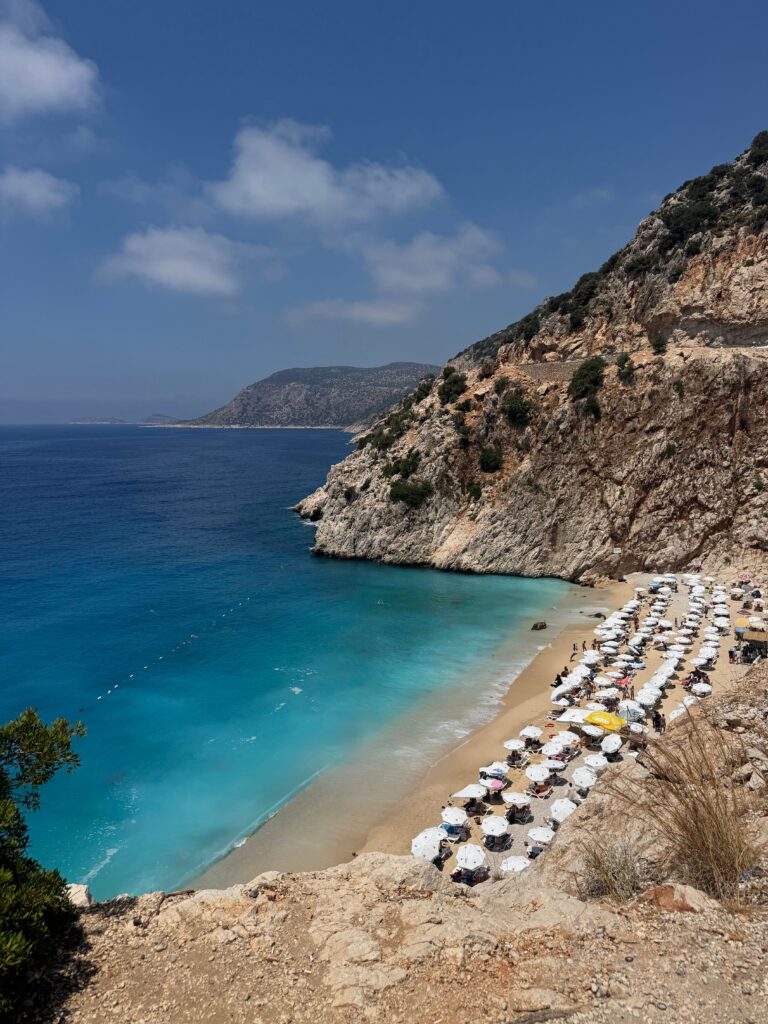
Between Kaş and Kalkan, a flight of steep concrete steps drops from the highway down a narrow gorge to Kaputaş Beach — one of the most photographed stretches of coast in Turkey, and for good reason. The water here shifts through improbable shades of turquoise depending on the light, framed by pale cliffs on both sides. It’s council-run, so access is straightforward, but the climb back up in the afternoon heat is no joke — go early if you can.
We’ve covered parking, the best time of day to go and what to expect from the steps in detail in our full Kaputaş Beach guide.
See the Kaputaş & Blue Cave Boat Tour →
Note that this is the Blue Cave near Kaş — a different, larger cave to the one near Ölüdeniz and Butterfly Valley in the Fethiye area, which we cover (including whether you can actually swim in it) in our Butterfly Valley & Blue Cave guide.
Day Two: Patara, Where the Sea Used to Reach the Steps
Give Patara a full morning. This was once the capital of the Lycian League, and the site is large enough that rushing it defeats the point. Entry runs on the Müze Kart system — currently around 200 TL for 2026, available as a physical card or a digital QR pass on your phone, and valid for a year at Patara plus dozens of other ancient sites and museums across Turkey.
Past the ticket gate, the ruins unfold gradually: a sprawling stretch of tumbled city walls and rock-cut tombs first, then the real centrepiece — a Roman theatre built to hold around 6,000 people, with acoustics so good that a voice carries cleanly from the stage to the back row and back down again. Climb to the very top tier and you’ll find a huge old wild pear tree offering the only real shade in the place, and a fine excuse to sit for a while.
From there, the path leads to Patara’s most important structure: the Meclis Binası, or Parliament House, restored between 2008 and 2011. A large scale model beside the building shows what it looked like when complete, and scattered around its perimeter are ancient inscriptions — including a tombstone honouring one Dionysos, remembered in its epitaph as the craftsman who “roofed the wide span of the Odeon.” Look out, too, for a decidedly out-of-place boat-shaped structure nearby — nobody seems entirely sure why it’s there, but the general theory is that it’s a leftover prop from one of the historical films shot on location at Patara over the years.
Continue on to Harbour Street, right in front of the Parliament House, and it takes a moment to register what you’re looking at: in antiquity, the sea came all the way up to this street. Centuries of earthquakes and silt carried down by wind and rivers have pushed the coastline hundreds of metres away, leaving the old harbour road stranded well inland — one of the more quietly astonishing details at the whole site.
This is only a taste of Patara’s history — for the deeper story behind Nero’s bathhouse, the lighthouse that was painstakingly rebuilt stone by stone, and the myth tying Apollo’s birth to this exact stretch of coast, our full Patara ancient city guide covers it in detail.
🚙 See Patara With
Xanthos & Saklıkent
A guided day tour is the easiest way to cover Patara’s ruins alongside the nearby Xanthos ruins and Saklıkent Gorge, with hotel pickup from Kaş or Kalkan included.
✅ Free cancellation up to 24 hours before · ✅ Reserve now, pay later
See the Xanthos & Patara Tour →Patara Beach: Turkey’s Longest Stretch of Sand (and a Turtle Nursery)
The ruins and the beach share the same entrance ticket, and the sand is barely a minute’s drive — or an easy walk — from the theatre. Patara Beach runs for roughly 15 kilometres of fine, soft sand backed by dunes rather than hotels, with proper waves rolling in off the open Mediterranean. It’s also a protected nesting ground for the endangered loggerhead sea turtle, Caretta caretta, so the beach stays deliberately undeveloped — no sunbeds dug into the sand, no beachfront construction, just an enormous open shoreline.
A single municipality-run social facility sits behind the beach, and its menu board is refreshingly cheap by seaside standards:
| Item | Approx. Price (2026) |
|---|---|
| Tea (çay) | 40 TL |
| Coffee | 100 TL |
There’s no obligation to buy anything from the facility, either — plenty of visitors simply bring their own food and drink and set up on the sand for the afternoon, which is exactly what the low-key, unfussy character of this beach seems to invite.
Climbing the Patara Dunes for Sunset
Save the last hour of daylight for the Patara Kum Tepeleri — the sand dunes rising just behind the beach, reached along a rough, rutted track through a stretch of pine forest. It’s a bumpy approach, but the payoff is a genuine desert landscape a few minutes’ walk from the Mediterranean: wind-carved ridges of pale sand with the ancient city and the sea visible in the distance.
Two packing notes worth taking seriously: walking on the dunes is far more tiring than it looks, so bring a pair of flip-flops to swap into rather than fighting sand-filled trainers, and the wind up there can be surprisingly fierce — enough to whip fine sand into your eyes, so sunglasses are close to essential rather than optional. It’s also, unsurprisingly, one of the most popular photo spots on this stretch of coast; a small flower picked from the surrounding scrub makes a nice hand-held prop if you want the shot, and more than one visitor has left wishing they’d packed something a little more “desert expedition” than beachwear for the pictures. Whatever you’re wearing, the sunset itself — pink light spreading over the dunes with the old lighthouse in silhouette — is worth the detour on its own.
Planning Your Own Kaş–Patara Weekend
- Getting there: Kaş sits around 185 km (roughly 3 hours by car) from Antalya along the coastal D400 highway. See our Antalya Airport to Kaş transfer guide for transport options, or our Kaş day trip guide if you’re basing yourself in Antalya instead.
- Getting between Kaş and Patara: Patara is roughly 30 minutes south of Kaş by car, just off the D400, or reachable by dolmuş minibus and organised day tours.
- Museum pass: A Müze Kart covers entry to Patara and is worth it if you’re visiting more than one or two ancient sites during your stay.
- Best time to go: May is a sweet spot — the season is already up and running, the sea is warming, and the crowds are still well below peak summer.
- What to pack: Comfortable walking shoes for the ruins, flip-flops and sunglasses for the dunes, swimwear for both Kaputaş and Patara, and cash in Turkish lira for the municipal cafés.
- Where to stay: Basing yourself in Kaş makes the most sense for this loop — see our pick of the best hotels in Kaş.
Planning more of the Kaş area? See the best excursions from Kaş, our Meis (Kastellorizo) day trip guide, the full Kaputaş Beach guide, our in-depth Patara ancient city guide, and — if your trip continues toward Fethiye — our Butterfly Valley & Blue Cave guide.
Frequently Asked Questions
How many days do you need for Kaş and Patara?
Two days covers the essentials comfortably — a full afternoon and evening in Kaş, then a full day at Patara including the ruins, the beach and the dunes. Add a third day if you want to fit in diving, a Kekova boat trip or the Meis island crossing.
Is Patara Beach free to visit?
The beach is included in the same Müze Kart-covered ticket as the ancient city, since they share one entrance. There’s no separate charge for the sand itself once you’re inside.
Do I need the Müze Kart for Patara?
You’ll need either a Müze Kart or a standard entrance ticket to get into the site. The Müze Kart is the better value option if you’re planning to visit other ancient sites or museums in Turkey within the year.
Can you swim at Kaputaş Beach?
Yes — the water is deep and clear close to shore, making it good for swimming, though the pebbly beach and the steep staircase down mean it’s worth timing your visit outside the midday heat.
🗺️ Ready for Your Own
Kaş & Patara Trip?
Compare guided tours and boat trips covering Kaş, Kaputaş and Patara, with easy online booking and free cancellation on most options.
✅ Free cancellation up to 24 hours before · ✅ Reserve now, pay later
Browse Kaş & Patara Tours →Page last updated: September 2026.
🚗 Need a Private Transfer or Luxury Vehicle in Antalya?
We arrange private airport transfers, intercity transfers and luxury vehicle hire across the Antalya region. Message us on WhatsApp for a quick quote.
💬 WhatsApp +90 533 653 02 90