
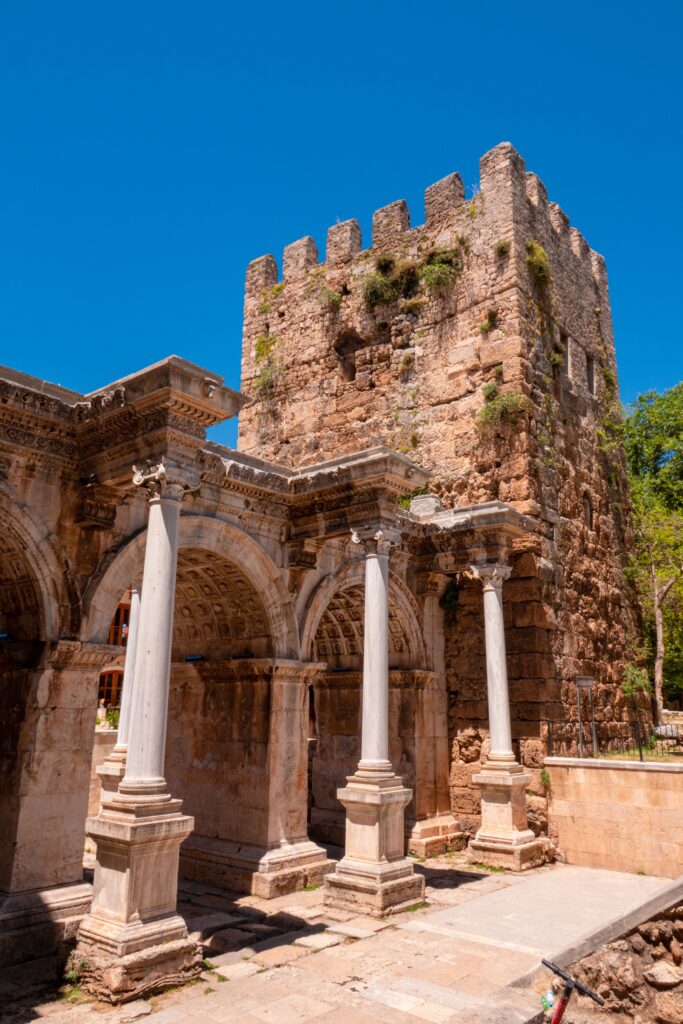
Most visitors come to Antalya for the coastline and end up staying for the history. Walk through the old city gate and you’re standing where a Roman emperor once stood; wander two streets over and you’re inside an Ottoman merchant’s house. Few places on the Turkish coast let you cross two and a half thousand years of architecture on foot, in an afternoon, without a guide or a museum ticket. Here’s how to actually see it, from the Roman ruins outside the city to the Ottoman streets inside it.
Skip the research, book a guided history tour
✅ Free cancellation up to 24 hours before · ✅ Reserve now, pay later
See Perge, Aspendos & Side Tours ›📝 A Local’s Note
Roman sites and Ottoman streets ask for opposite conditions. Aspendos and Perge have almost no shade, so go early and bring water. Kaleİçi, on the other hand, is at its best in the late afternoon, when the stone walls hold the day’s warmth and the light along the harbour turns gold.
If a downpour catches you in the old town, don’t waste it, several small workshops in Kaleİçi run hands-on traditional mosaic lamp-making sessions. It’s one of the better rainy-day fixes in the city, and a genuinely local souvenir to take home.
The Roman Layer: Gates, Theatres and a City Built to Last
Antalya’s most photographed monument is also its oldest. Hadrian’s Gate, standing at the entrance to Kaleİçi, was raised in AD 130 to mark a visit from the emperor himself. It started life as a freestanding ceremonial arch and was only later folded into the city’s defensive walls, which may be exactly why it survived: one of the best-preserved Roman gates anywhere in the world, still framing the street it was built for. It’s the natural starting point for any walk through the old town, and our Kaleİçi walking guide maps out a route from here through the rest of the district.
Roughly half an hour outside the city, Perge shows what a working Roman provincial city actually looked like. Founded earlier in the Hellenistic period, it was substantially rebuilt and expanded under Roman rule in the 3rd century AD, and most of what you walk through today, the shop-lined colonnaded street, the bath complex, mosaic floors still visible underfoot, dates from that expansion. Look for the ruined but still legible monumental gate funded by Plancia Magna, a wealthy local woman whose name appears repeatedly across the site, and the vast stadium, built to hold around 12,000 spectators for games and gladiator contests. Our Perge guide covers tickets, layout and how much time to set aside.
Not far from Perge, the Aspendos Theatre is the single best piece of evidence for how good Roman engineers actually were. Built in the 2nd century AD, it remains one of the best-preserved Greco-Roman theatres anywhere in the world, acoustically precise enough that unamplified concerts are still staged there today. Look up at the stage building for a relief of Dionysus, the god of wine and theatre, carved directly into the Roman-era stonework. Part of the reason it survived so intact is later history, not earlier: in the 13th century the Seljuks restored the theatre and used it as a palace, which likely kept it standing rather than left to crumble. Our Aspendos Theatre guide has current ticket prices and the best times to beat the crowds, and if you can’t decide which ruin deserves your day, our Aspendos vs Perge comparison breaks down the difference.
Further east, at Side, the Roman layer meets the sea directly. The twin Temples of Apollo and Athena sit side by side on the old harbour, about as close to a postcard Greco-Roman ruin as this coast gets, especially at sunset. Look closely at the temple stonework for a carved Medusa head, placed there in antiquity to ward off evil spirits and protect the sanctuary, a small but striking detail most visitors walk straight past. Our Side guide and Side day trip guide both cover how to combine the ruins with the rest of the town in a single visit.
The Ottoman Layer: Kaleiçi’s Streets and Its Oldest Mosque
Kaleİçi’s foundations go back to the Roman city, but the neighbourhood you actually walk through today took its current shape after Antalya came under Ottoman control in the 14th century. The architecture is unmistakable once you know what you’re looking at: stone-built ground floors topped with timber-framed white upper storeys, and the trademark cumba, a bay window that juts out over the street, letting upper floors catch the sea breeze and a bit more daylight than the narrow lanes below allow. Many of these restored merchant houses are now boutique hotels; our Kaleİçi boutique hotels guide lists the best-converted examples if you’d rather sleep inside the history than just walk past it.
Just inside the old town, the Yivli Minare Mosque, Antalya’s oldest, is easy to spot from a distance thanks to its minaret, built with eight distinctive vertical flutes running up the shaft rather than the smooth cylindrical towers seen elsewhere. Step inside and the contrast with the more ornate mosques of Istanbul is immediate: plain stone walls, almost no decorative tilework, nothing competing for your attention. It reads less as an oversight and more as a deliberate, older sense of what a place of worship should feel like. Exact construction records are thin, but it predates most of what stands around it and remains one of the clearest surviving markers of the city’s early Turkish period.
Side, again, offers a useful contrast: its own small Ottoman-era old town sits directly beside the Roman ruins, close enough that you can cross from one architectural period to the other in a five-minute walk, a rare and slightly disorienting kind of layering that’s worth experiencing at least once.
How to See It All Without Rushing
Realistically, this splits into two different days. Spend one on foot inside Kaleİçi: start at Hadrian’s Gate, work through the old streets toward Yivli Minare, and finish at the harbour, stopping for a balık ekmek (grilled fish sandwich) from one of the stalls near the marina along the way, a small, unglamorous local classic that’s worth trying regardless of history. For deeper coverage of Antalya’s finds from all three periods in one place, the Antalya Museum is worth an hour on the same day.
Give the second day to Perge and Aspendos together, they sit close enough to combine easily, either on a guided tour or by taxi. If your schedule allows a third day, push further to Side for the harbour temples, or cool off afterwards at Düden Waterfalls, where the Mediterranean meets the falls just outside the city. If you’re building a longer trip around all of this, our 4-day Antalya itinerary already threads most of these stops into a single route.
🏛️ Let a Local Guide
Walk You Through It
Skip the guesswork on opening hours and history. Compare guided tours to Perge, Aspendos and Side, with pickup included.
✅ Free cancellation up to 24 hours before · ✅ Reserve now, pay later
Browse Antalya History Tours →Frequently Asked Questions
Where can I see Roman architecture in Antalya?
Start with Hadrian’s Gate right at the entrance to Kaleİçi, then head out to Perge and the Aspendos Theatre, both roughly 30–40 minutes from the city centre. For Roman ruins directly on the coast, Side’s Temple of Apollo is one of the most photographed spots in the region.
Where can I see Ottoman houses in Antalya?
Inside Kaleİçi, Antalya’s old town. Enter through Hadrian’s Gate and the restored stone-and-timber merchant houses, many now boutique hotels and cafes, line the streets from there.
Is Aspendos Theatre still used today?
Yes. Thanks to its exceptional acoustics, Aspendos still hosts opera, ballet and concert performances, including the annual Aspendos International Opera and Ballet Festival.
Can I visit Perge, Aspendos and Side in one day?
Perge and Aspendos comfortably fit into one day together. Adding Side as well makes for a long day, so it’s usually more relaxed as a separate trip, or booked as a combined guided tour that handles the driving for you.
The Takeaway
Antalya rarely gets credit as a history destination, most people picture the beaches first, but the architecture here spans a Roman emperor’s gate, a still-functioning 2,000-year-old theatre, and Ottoman streets that have barely changed shape in centuries, all within reach of the same coastline you came for. You don’t need a museum pass or an expert guide to notice it, just Hadrian’s Gate, a decent pair of walking shoes, and a morning to spare before the beach reclaims your afternoon.
More Antalya history & planning guides
Page last updated: August 2026.
🚗 Need a Private Transfer or Luxury Vehicle in Antalya?
We arrange private airport transfers, intercity transfers and luxury vehicle hire across the Antalya region. Message us on WhatsApp for a quick quote.
💬 WhatsApp +90 533 653 02 90