
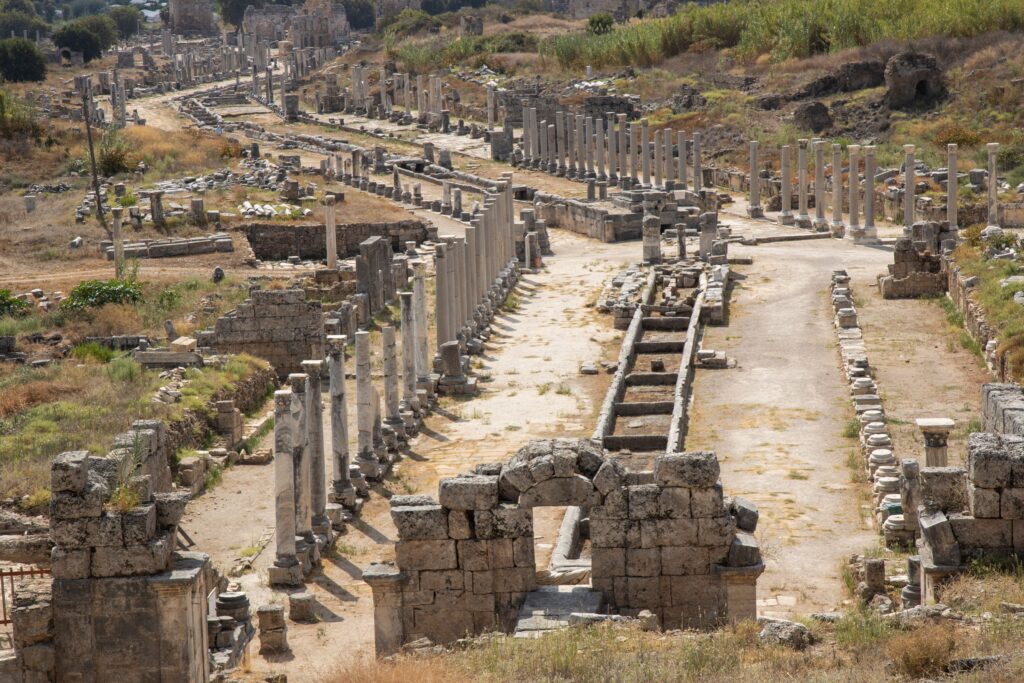
Just a short drive east of Antalya lies Perge, one of the most complete and rewarding ancient cities in Turkey. Unlike a single monument, Perge lets you wander an entire Greco-Roman city, down its grand colonnaded street, past a huge stadium, Roman baths, and monumental gates. It is a highlight for history lovers and easily combined with Aspendos. Here is a local’s guide.
Book a Perge & Aspendos tour
✅ Free cancellation up to 24 hours before · ✅ Reserve now, pay later
Check Price & Availability ›📝 A Local’s Note
There’s a small café near the entrance but nothing once you’re inside the site itself, so fill up on water before you go in rather than counting on buying more partway round.
If you’re pairing Perge with Aspendos in one day, visit Perge first while it’s still cool. It’s more spread out and shadeless than Aspendos, so doing the walking in the cooler morning hours makes a real difference.
What Was Perge?
Perge was one of the most important cities of ancient Pamphylia, founded in the Bronze Age and, according to tradition, settled by Greek colonists after the Trojan War. It reached its peak under Roman rule in the 2nd and 3rd centuries AD, when most of what you see today, the theatre, stadium, baths and colonnaded street, was built. The city had its own local version of the goddess Artemis, Artemis Pergaia, whose image appeared on Perge’s coins for centuries, and it is also one of the cities the Apostle Paul is recorded as visiting on his first missionary journey, around 46 to 48 AD.
The Highlights
Perge’s showpiece is its long colonnaded main street, once lined with shops and a water channel running down the centre, leading to the striking Hellenistic Gate with its two round towers. Don’t miss the vast stadium, one of the best-preserved in Anatolia, the Roman baths, the agora, and the theatre. Many of the exquisite statues found here, including that of Plancia Magna, the influential woman who shaped the city, are now displayed in the Antalya Museum.
| Practical info | Perge |
|---|---|
| Entry fee | A site ticket applies; the Müzekart and Mediterranean Museum Pass are generally valid |
| Location | Near Aksu, about 17 km east of Antalya |
| Time needed | 1.5 to 2 hours to explore properly |
| Best combined with | Aspendos and the Kurşunlu Waterfall nearby |
Fees and hours change; check muze.gov.tr before visiting.
How to Get There
Perge is about 17 km east of Antalya, near Aksu, roughly a 25 to 30 minute drive. You can reach it by car, taxi, or on an organised tour, which usually combines it with the theatre of Aspendos, and sometimes Side or the Kurşunlu Waterfall, for a full day of history. Public transport gets you close (to Aksu), with a short taxi to the site.
Tips From a Local
Wear comfortable shoes and bring water, a hat, and sun protection, as the site is large and largely unshaded. Go earlier in the day to avoid the midday heat. Pair your visit with the Antalya Museum to see Perge’s magnificent statues in context, and combine it with Aspendos, which is close by, for the region’s two greatest ancient sites in one day.
Frequently Asked Questions
Is Perge worth visiting?
Yes. Perge is one of Turkey’s most complete ancient cities, where you can wander a grand colonnaded street, a huge stadium, baths, and gates. It is a highlight for anyone interested in history.
How far is Perge from Antalya?
About 17 km east near Aksu, roughly a 25 to 30 minute drive. It is easy to reach by car, taxi, or organised tour, often combined with Aspendos.
Can you visit Perge and Aspendos together?
Yes, they are close and often combined on a single day trip, sometimes with Side or the Kurşunlu Waterfall, making a rich day of ancient history.
Does the Museum Card cover Perge?
Generally yes, the Turkish Müzekart and the Mediterranean Museum Pass are accepted. Check current details, as fees and conditions can change.
More ancient Antalya
Page last updated: September 2026.
🚗 Need a Private Transfer or Luxury Vehicle in Antalya?
We arrange private airport transfers, intercity transfers and luxury vehicle hire across the Antalya region. Message us on WhatsApp for a quick quote.
💬 WhatsApp +90 533 653 02 90