
🔵 Intro
Patara doesn’t get nearly the visitor numbers of Ephesus or Side, and that’s exactly its appeal. This was once the capital of the Lycian League — a confederation the philosopher Montesquieu later held up as one of history’s most balanced systems of government — and its ruins now sit half-buried in dunes behind one of Turkey’s longest, least developed beaches.
Near Kaş in Antalya province, Patara pairs a genuinely important ancient city with 15 kilometres of protected sand where loggerhead turtles still nest every summer. Here’s what to see, what it costs in 2026, and how to plan the trip.
🏛️ Explore Ancient
Patara & Its Beach
Guided day trips to Patara’s ruins and beach from Kaş, Kalkan and Fethiye, often combined with Xanthos and Saklıkent Canyon.
✅ Free cancellation up to 24 hours before · ✅ Reserve now, pay later
Check Price & Availability →🔵 What Was Patara?
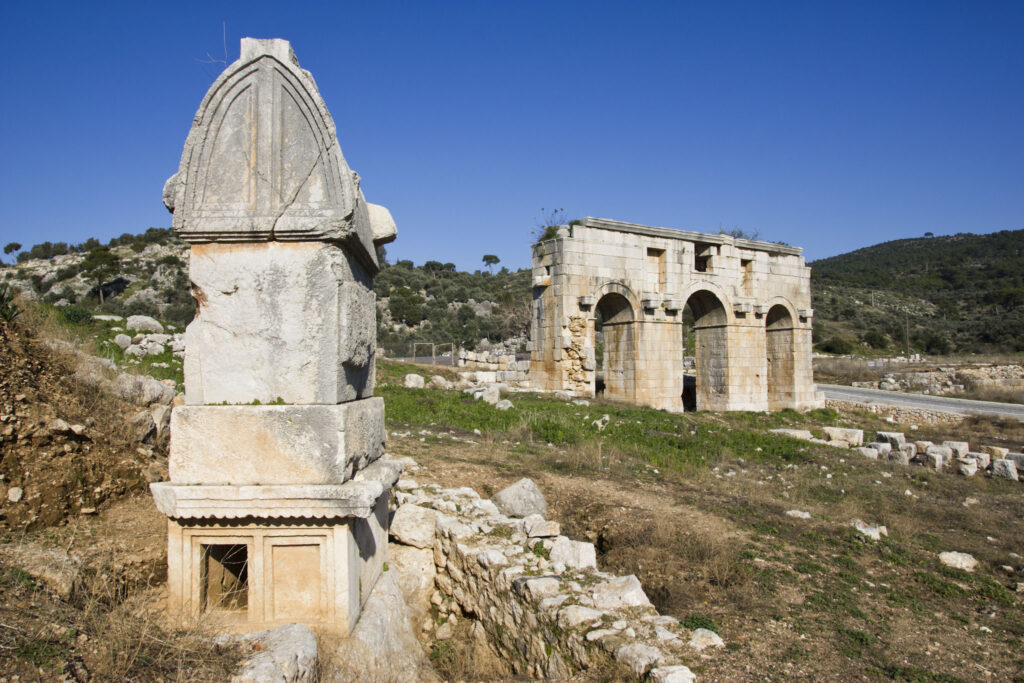
Patara was the capital and main naval harbour of the Lycian League, a confederation of city-states that governed the Lycian region in the centuries before and after Rome’s arrival. Excavations here have run almost continuously since 1988, and the site keeps growing: a monumental city gate, a Roman theatre, a colonnaded main street, a bathhouse and one of the best-preserved council buildings from the ancient world have all been uncovered from under metres of wind-blown sand.
What makes Patara stand out isn’t just its size — it’s how directly it connects to two very different stories: the origins of representative government, and the birth myth of the god Apollo.
🔵 The Lycian League Parliament House
The single most significant building at Patara is the Lycian League’s assembly hall, where delegates from the league’s member cities met to vote on shared decisions — everything from military matters to disputes between towns. The 18th-century French philosopher Montesquieu cited the Lycian League’s proportional voting system as a model of balanced government, and this hall was where it actually happened.
The building measures roughly 43 by 30 metres and held around 1,400 people, with a roof originally spanning that width without a single interior column — an engineering feat with no known parallel elsewhere in Lycia. Excavators recovered numerous official League decrees inside, many concerning cities other than Patara itself, confirming this was a genuine regional government chamber rather than a purely local one. Its historical importance was significant enough that Turkey’s Grand National Assembly (TBMM) itself took charge of the restoration.
🔵 Nero’s Bath and the Great Lighthouse
Two of Patara’s most striking structures both date to the reign of Emperor Nero, and both carry a bit of imperial intrigue.
Nero’s Bath is considered the oldest well-preserved Roman bathhouse in Anatolia. Unlike a classic Turkish hamam, there was no system for pouring water over yourself — bathers submerged together in large communal pools in the cold and hot sections. Underneath the marble floor sits a hypocaust: a hollow space on brick piers through which hot air and smoke from an external furnace circulated to heat the building before escaping through wall flues. The building’s dedication inscription had Nero’s name chiselled out after his death (a common punishment for disgraced emperors) and replaced with his successor Vespasian’s — though the provincial governor named alongside it let historians work out that Nero was the true builder.
The Patara Lighthouse, built around 64–65 AD as a prestige project for Rome’s newly formed province of Lycia, is one of the largest structures of its kind to survive from antiquity. Its dedicatory inscription ends with Nero’s own words: “I built this lighthouse for the safety of sailors.” Today the ruins stand around 5 metres tall, sitting well back from the sea behind the dunes — but in antiquity the lighthouse stood right at the water’s edge, tall enough (over 30 metres once fully reconstructed) to be visible from Rhodes. A second inscription on the base even reveals there were originally two matching lighthouses (an “antifaros” pair), honouring a governor named Priscus for eight years of honest, bribe-free rule.
When the lighthouse eventually collapsed, it fell straight into the sand and was buried whole rather than scattered or looted. Archaeologists were able to number and match roughly 2,700 fallen stones back to their original positions — reassembling the tower like a giant jigsaw puzzle using its own original material.
🚙 See Patara With
Xanthos & Saklıkent
Most day tours from Kaş or Kalkan combine Patara with the nearby Xanthos ruins and Saklıkent Gorge for a full day of Lycian history and nature.
✅ Free cancellation up to 24 hours before · ✅ Reserve now, pay later
See Patara Tours →🔵 Apollo’s Birthplace and the Leto Sanctuary
Ancient sources repeatedly tie the god Apollo directly to Lycia, and to Patara specifically. Homer calls him “Lykagenes” — “born in Lycia” — in the Iliad, and the 5th-century BC poet Pindar describes Apollo as ruling both Lycia and the Greek island of Delos jointly. Linguists have also pointed to the name “Apalypunas,” found on tablets excavated at Troy, as evidence that Apollo’s name has Anatolian rather than purely Greek roots.
The myth of his birth centres on his mother Leto: fleeing the jealous wrath of Hera, who had forbidden any land on earth from sheltering her, Leto eventually found refuge in a palm grove, where she gave birth to Apollo while holding onto a palm tree. That site became sacred and was later marked with a sanctuary — the Leto Sanctuary. Ancient accounts also describe a nearby lake sacred to Apollo, called the “wheel lake.” Remarkably, both features — the palm grove and the lagoon-like lake, the former ancient harbour — still exist side by side at Patara today, a combination found nowhere else. The palms growing there now line up with the ancient Roman road grid, suggesting a continuous link stretching back at least 2,000 years. Apollo’s family ties run deeper into Anatolia too: the Letoon sanctuary dedicated to his mother sits just 8 km from Patara, and both “Leto” and “Artemis” (Apollo’s twin sister) trace to Luwian, not Greek, roots.
🔵 Harbour Street, the Agora and the Theatre
Patara’s commercial backbone was Harbour Street, a north–south avenue running straight down to the port. At 12.6 metres wide it was unusually generous for Lycia — closed to wheeled traffic and lined on both sides with covered colonnades and shops, functioning as an ancient pedestrian boulevard. Anyone arriving from the harbour, or leaving the Agora, would have passed along it to reach the theatre, the assembly hall, or the market squares. Excavated finds show the street stayed continuously in use from the 1st century AD through to around the 7th century.
The theatre, reached directly from this street, was completed with funding from a local Patara woman, Vilia Procula, and later hosted gladiator and animal contests during the Roman period.
🔵 How the Harbour Became a Marsh
Patara’s sheltered natural bay was the source of its wealth for centuries — until the ancient Xanthos River (today’s Eşen Çayı), which empties into the sea just north of the site, gradually choked it with silt. As the river mouth narrowed, the bay lost its connection to the open sea and slowly turned into a lagoon, then a marsh. Small boats could still enter it as recently as around 600 years ago; when the traveller and archaeologist Charles Texier visited in 1836, he described the old harbour as thick with vegetation and fully swamped. That marsh — still known locally as the “wheel lake” from its role in the Apollo myth — remains today, and its high water table and dense reed beds make it one of the toughest areas at Patara to excavate: of the two ancient harbour towers that once held a defensive chain between them, only faint traces of one are visible above the waterline, and the other has never been located.
🔵 Patara Beach and the Caretta Caretta Turtles
Patara Beach stretches around 15 kilometres — one of the longest continuous beaches on the Mediterranean — backed by wind-sculpted dunes rather than hotels. It’s protected specifically because it’s a nesting site for the endangered loggerhead turtle (Caretta caretta), which returns here every year to lay eggs in the sand.
Yes, you can swim here. The beach and sea are open to visitors, but because of the turtles, a fairly strict set of protections applies: no sunbeds, umbrellas or structures may be dug into the marked nesting zones, no lights or loud noise on the beach after dark during nesting season (roughly May to October), and no digging or disturbing the sand where nests are marked. Development has been kept off the beach entirely — a battle led by the archaeological excavation team through the 1980s and ’90s against encroaching hotel construction, which is exactly why the dunes still look untouched today. Visitors are asked to enjoy the beach quietly and leave the nests undisturbed rather than treat it as a standard resort stretch.
🔵 Getting to Patara, Entrance Fees and Hours (2026)
Patara sits just outside Gelemiş village, in the Kaş district of Antalya province, roughly between Kalkan and Kaş.
- By car: Patara is just off the D400 coastal highway — well signposted from both Kalkan (about 15 minutes) and Kaş (about 30 minutes).
- By dolmuş: Regular minibuses run between Kaş, Kalkan and Fethiye and can drop you at the Patara turn-off, from where it’s a short onward hop into Gelemiş.
- By air: The nearest airport is Dalaman (around 115 km); Antalya Airport is a further but still workable alternative, especially if combining Patara with other Antalya-coast stops.
- On a tour: Day trips from Kaş, Kalkan or Fethiye often bundle Patara with nearby Xanthos and Saklıkent Gorge into one full day.
| Ticket | Approx. Price (2026) |
|---|---|
| Adult (foreign visitors) | ~15 EUR |
| Müzekart (Turkish citizens, annual pass) | ~100 TL — valid at Patara, Xanthos and other sites for a year |
| Ticket office hours | 08:00–19:30 |
| Site access until | 20:00 |
Reported prices vary a fair bit between sources and by season, so treat this as a 2026 ballpark and expect to pay in euros or the TL equivalent at the gate. The Müzekart is accepted here for Turkish citizens, unlike at some privately run nature parks in the region.
🔵 Where to Eat Near Patara
Gelemiş, the village beside the ruins, has stayed deliberately low-key — expect family-run pensions and garden restaurants rather than resort dining. Ayşe Abla’s Gözleme Evi is a local favourite for home-style gözleme (savoury filled flatbreads) cooked to order, and several seafront restaurants such as Greece Rodos Restaurant serve fresh Mediterranean seafood, meze and sea views in the evening. It’s a place to eat simply and well rather than to seek out fine dining.
🔵 Practical Tips for Visiting
- Bring water and sun protection: The site is large, exposed and has very little shade — this is not a quick 30-minute stop.
- Wear proper shoes: Paths cross sand, gravel and uneven ancient stone, so sandals aren’t ideal.
- Pack swimwear: The beach is included in the same site — many visitors combine ruins in the morning with a swim afterward.
- Respect the turtle nesting zones: Marked areas of the beach should not be walked on, dug into, or lit up at night during nesting season.
- Go early or late in the day: Midday sun on the exposed ruins and dunes is intense in July and August.
- Allow half a day minimum: Between the parliament house, baths, lighthouse, theatre, harbour street and beach, the site rewards a slow, unhurried visit.
🔵 Frequently Asked Questions
Can you swim at Patara Beach?
Yes — the sea is open to swimmers, though marked turtle-nesting areas of the sand should be left undisturbed, especially between May and October.
Is the Müzekart valid at Patara?
Yes, for Turkish citizens — the annual Müzekart pass covers Patara along with Xanthos and other regional sites.
How do I get to Patara without a car?
Regular dolmuş minibuses connect Kaş, Kalkan and Fethiye to the Patara turn-off, or you can join an organised day tour from any of those towns.
What is Patara famous for?
It was the capital of the Lycian League and home to one of the best-preserved ancient assembly buildings in the world, as well as a 15 km undeveloped beach that’s a major nesting site for loggerhead sea turtles.
🔵 Final Thoughts
Patara rewards visitors who give it time: a genuinely important seat of ancient government, two Nero-era monuments with real stories behind them, a birth myth tied to a real landscape you can still walk through, and an untouched beach that exists precisely because people fought to keep it that way. Pair the ruins with a swim and you’ve got one of the more complete days out on this stretch of coast.
🎒 Ready to Visit
Ancient Patara?
Compare guided tours to Patara’s ruins and beach from Kaş, Kalkan and Fethiye, with hotel pickup and easy online booking.
✅ Free cancellation up to 24 hours before · ✅ Reserve now, pay later
Book Your Patara Tour →🌴 More Ancient Sites & Day Trips
Sapadere Canyon Guide · Antalya’s Roman & Ottoman Heritage · Best Beach Clubs in Antalya · All Activities
Page last updated: August 2026.