
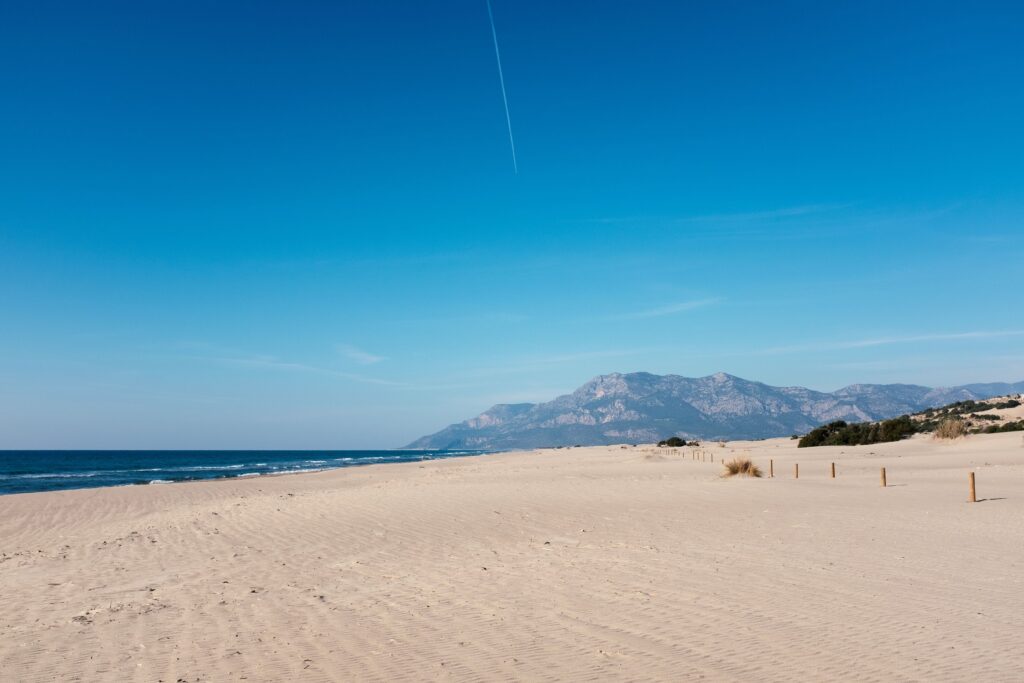
Patara is two extraordinary places in one ticket: a major ancient city that was once the capital of the Lycian League, and an 18-kilometre sweep of wild golden sand, one of the longest beaches in the Mediterranean. You can walk among 2,000-year-old ruins with a genuinely important history, then swim off an empty, dune-backed beach in the same afternoon. Because the whole site sits inside a protected area, there are no hotels or beach bars on the sand itself, which keeps it gloriously wild. Here is your local’s guide to Patara.
Book a Patara & Lycian day tour
✅ Free cancellation up to 24 hours before · ✅ Reserve now, pay later
Check Price & Availability ›📝 A Local’s Note
The walk from the entrance area to the beach itself is a good 15–20 minutes across open ground with little shade, so factor that into your timing and bring water for the walk, not just for lounging on the sand afterward.
If you’re driving yourself, the access road can get busy on summer weekends when day-trippers from Kalkan and Kaş tend to arrive in the same late-morning window. An early start avoids the bottleneck as much as the heat.
The Ancient City: Capital of the Lycian League
Patara was the capital and main naval harbour of the Lycian League, a confederation of city-states that governed the region before and after Rome’s arrival. Excavations have run almost continuously since 1988, and the site keeps growing: a monumental city gate, a Roman theatre, a colonnaded main street, a bathhouse, and one of the best-preserved council buildings from the ancient world have all been uncovered from under metres of wind-blown sand. Patara is also traditionally regarded as the birthplace of Saint Nicholas.
The Lycian League Parliament House (Bouleuterion) is the single most important building on site, the beautifully restored assembly hall where delegates from the league’s member cities met to vote on shared decisions. The 18th-century philosopher Montesquieu cited the Lycian League’s proportional voting system as a model of balanced government, and this hall is where it actually happened. It measures roughly 43 by 30 metres and once held around 1,400 people under a roof spanning that width without a single interior column, an engineering feat with no known parallel elsewhere in Lycia. Its importance was significant enough that Turkey’s Grand National Assembly took charge of the restoration.
Nero’s Bath, considered the oldest well-preserved Roman bathhouse in Anatolia, and the Patara Lighthouse, one of the largest of its kind to survive from antiquity, both date to the reign of Emperor Nero. The lighthouse’s dedication ends with Nero’s own words, “I built this lighthouse for the safety of sailors.” When it eventually collapsed it fell straight into the sand rather than being scattered, and archaeologists were able to number and match roughly 2,700 fallen stones back to their original positions, effectively reassembling the tower like a giant jigsaw puzzle.
Ancient sources also tie Patara to the god Apollo. Homer calls him “Lykagenes”, born in Lycia, and myth places his mother Leto giving birth to him in a palm grove while fleeing the jealous Hera. That site was later marked by the Leto Sanctuary, and remarkably the palm grove and a nearby lagoon-like lake from the myth still exist side by side at Patara today. The commercial heart of the city was Harbour Street, a wide colonnaded pedestrian boulevard running down to the port, which stayed in continuous use from the 1st century AD to around the 7th century. That port was eventually silted up by the ancient Xanthos River and slowly turned into the marsh still visible today.
The Beach
Beyond the ruins stretches Patara beach: a vast, flat expanse of pale sand and dunes with barely any development. It is a strictly protected nesting site for loggerhead (Caretta caretta) turtles, so building is banned and the beach closes to lights and noise at night in season (roughly May to October). There are minimal facilities, just a small area near the entrance, so bring water, shade, and everything you need. The sense of open space is unlike anywhere else on this coast, and it exists precisely because the archaeological team fought off encroaching hotel development through the 1980s and ’90s.
| Practical info | Patara |
|---|---|
| Entrance fee | Around €15 per person; one ticket covers both the ancient city and the beach. Müzekart (Turkish citizens) usually includes entry |
| Opening hours | Ticket office 08:00–19:30, site access until 20:00 |
| From Kalkan | About 15–20 minutes by car (via Gelemiş village) |
| From Kaş | About 30–45 minutes by car |
| Time needed | Half a day (allow time for both ruins and a swim) |
Fees change seasonally; check muze.gov.tr before visiting.
Where to Eat Nearby
Gelemiş, the village beside the ruins, has stayed deliberately low-key, expect family-run pensions and garden restaurants rather than resort dining. Ayşe Abla’s Gözleme Evi is a local favourite for home-style gözleme cooked to order, and seafront spots such as Greece Rodos Restaurant serve fresh Mediterranean seafood and meze in the evening. It’s a place to eat simply and well rather than to seek out fine dining.
Local Tips
Go early or late to avoid the midday heat, as both the ruins and the beach are almost entirely unshaded. Wear proper shoes for the ruins, since paths cross sand, gravel and uneven ancient stone, and bring flip-flops or swimwear for the beach. Combine Patara with nearby Xanthos and Letoon for a superb Lycian history day, or simply make it a beach day with a dose of ancient history on the way in. No lights or disturbance on the beach at night in nesting season.
Frequently Asked Questions
Is Patara beach free?
No. One entrance fee (around €15) covers both the ancient city and the beach, since they sit inside the same protected site. A Turkish Müzekart usually includes entry.
Why is Patara famous?
It was the capital of the Lycian League, home to its parliament building and one of the world’s best-preserved ancient assembly halls, and is traditionally the birthplace of Saint Nicholas. It also has one of the longest, wildest beaches in the Mediterranean.
Can you swim at Patara Beach?
Yes, the sea is open to swimmers, though marked turtle-nesting areas of the sand should be left undisturbed, especially between May and October.
Are there facilities at Patara beach?
Very few. Because it is a protected turtle-nesting beach with no development, there is only a small service area near the entrance. Bring water, sun protection and shade.
How do you get to Patara from Kalkan or Kaş?
About 15–20 minutes by car from Kalkan, turning off toward Gelemiş village, or 30–45 minutes from Kaş. Regular dolmuş minibuses and organised Lycian day tours also serve the site.
More Kaş & Kalkan day trips
Page last updated: September 2026.
🚗 Need a Private Transfer or Luxury Vehicle in Antalya?
We arrange private airport transfers, intercity transfers and luxury vehicle hire across the Antalya region. Message us on WhatsApp for a quick quote.
💬 WhatsApp +90 533 653 02 90