
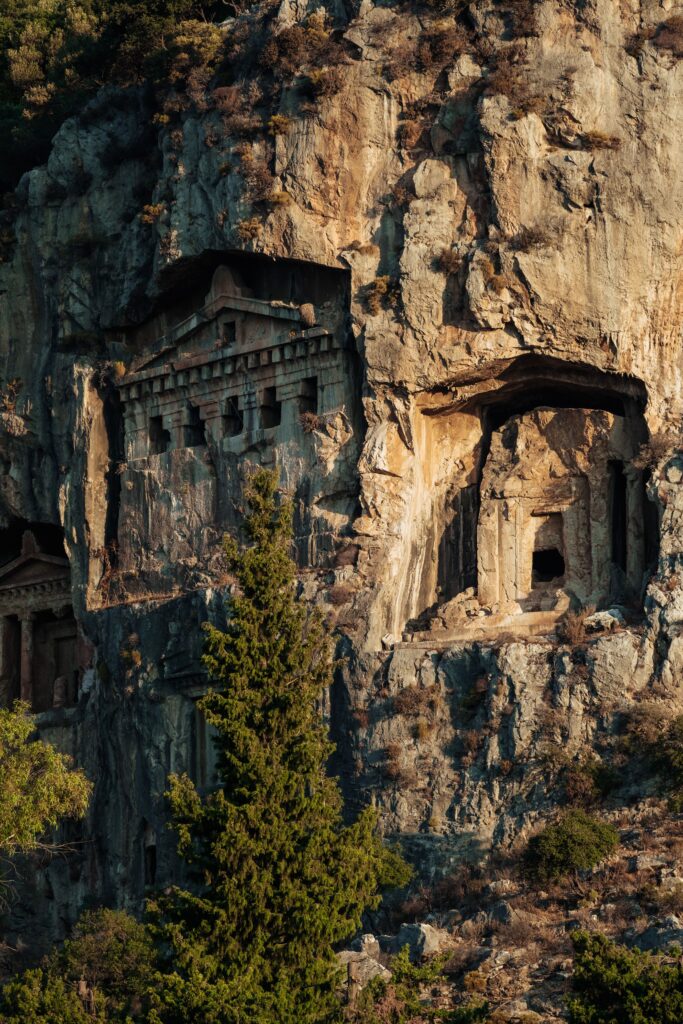
Xanthos and Letoon are, together, the single most important window we have onto the Lycian civilisation. Listed by UNESCO as one property in 1988, they were two halves of the same society: Xanthos the political and funerary capital, Letoon its sacred religious sanctuary, once linked by a processional road. For anyone interested in ancient history, this is one of the richest half-days on the whole coast, and it is still refreshingly uncrowded. Here is your local’s guide.
Book a Lycian heritage tour
✅ Free cancellation up to 24 hours before · ✅ Reserve now, pay later
Check Price & Availability ›📝 A Local’s Note
The submerged temple foundations at Letoon mean you’ll want water-friendly shoes if you want to get close for photos — the marble is often a few centimetres underwater, not just nearby.
There’s no real shop or café at either site, so bring snacks and plenty of water if you’re doing both back to back. The nearest proper services are back in Kınık village.
Xanthos: Capital of Lycia
Set on a hill above the Eşen (ancient Xanthos) River near Kınık village, Xanthos was the chief city of the Lycians. Its history is dramatic: twice, when facing overwhelming invaders (the Persians around 540 BC and the Romans under Brutus in 42 BC), the Xanthians are said to have chosen collective destruction over surrender. What survives is remarkable. Look for the distinctive Lycian pillar tombs, the Harpy Tomb, the great Inscribed Pillar covered in Lycian text, a fine Roman theatre and agora, Vespasian’s Gate, and a Byzantine basilica with mosaics.
A Honest Note on the Marbles
It is worth knowing before you go: many of the finest sculptures from Xanthos, including the celebrated Nereid Monument (the temple-tomb of the ruler Arbinas, around 380 BC) and the original reliefs of the Harpy Tomb, were removed to the British Museum by Charles Fellows in the 1840s. On site today you will see the monument’s base and high-quality replicas rather than the originals. It does not diminish the atmosphere of the place, but it is part of the site’s story and a topic of ongoing debate.
Letoon: The Sacred Sanctuary
A few kilometres south lies Letoon, the spiritual centre of the Lycian federation, dedicated to the goddess Leto and her twin children Apollo and Artemis. It is smaller, greener, and arguably more atmospheric than Xanthos. Three temple foundations sit beside a sacred spring, so part of the site is permanently flooded, and you will often see frogs and terrapins among the submerged marble. Letoon is also where the famous trilingual inscription (in Lycian, Greek, and Aramaic) was found, a key that helped scholars decipher the Lycian language. The stele is now in the Fethiye Museum.
| Practical info | Xanthos & Letoon |
|---|---|
| Entrance fee | Modest, around €3–5 each (a Müzekart usually covers both); check on site |
| Location | Near Kınık and Kumluova, in the Eşen (Xanthos) valley; the two sites are a few km apart |
| From Kalkan / Patara | Roughly 30–45 minutes by car; easy to combine with Patara |
| Best time | Early morning or late afternoon (both sites are largely unshaded) |
Tips from a Local
Both sites are quiet and lightly signposted, so a guide or a little reading beforehand pays off. Bring water, a hat, and sun protection, as shade is scarce. Xanthos involves stairs and uneven ground up to the acropolis, while Letoon is flatter and easier. The classic way to do it is to combine both with Patara for a full Lycian day, and photographers should aim for the golden light on the Xanthos acropolis late in the afternoon.
Frequently Asked Questions
Why are Xanthos and Letoon a UNESCO site?
They together preserve the fullest record of the Lycian civilisation, from its funerary architecture and political monuments at Xanthos to the religious sanctuary and key Lycian-language inscriptions at Letoon. UNESCO listed them as one property in 1988.
Where is the Nereid Monument now?
The Nereid Monument was taken to the British Museum in the 1840s, where it is reassembled and displayed. At Xanthos itself you see the base and replicas of the finest reliefs.
Can you visit Xanthos and Letoon together?
Yes, they are only a few kilometres apart and are best visited on the same trip, ideally combined with nearby Patara for a full day of Lycian history.
How far are Xanthos and Letoon from Kalkan?
Around 30 to 45 minutes by car, in the Eşen valley near Kınık and Kumluova. They are easy to reach with a hire car or on an organised Lycian tour.
More Kaş & Kalkan day trips
Page last updated: August 2026.
🚗 Need a Private Transfer or Luxury Vehicle in Antalya?
We arrange private airport transfers, intercity transfers and luxury vehicle hire across the Antalya region. Message us on WhatsApp for a quick quote.
💬 WhatsApp +90 533 653 02 90