
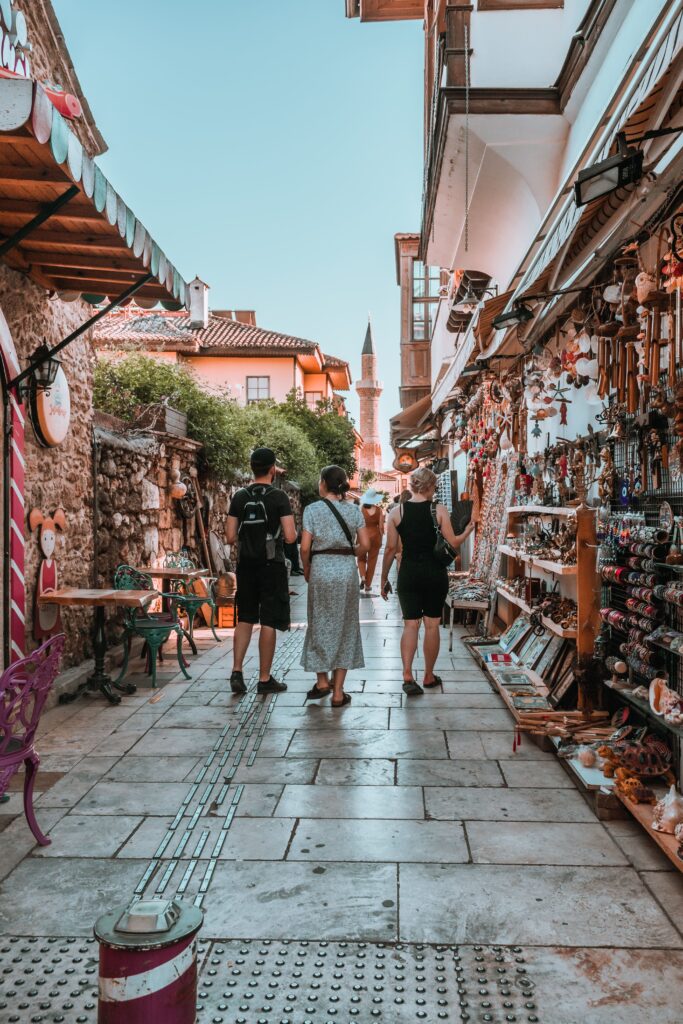
Shopping in Antalya spans two worlds: chaotic weekly street markets where local families haggle over cheese and cherries, and gleaming air-conditioned malls with international brands. Between them sit the artisan workshops of Kaleiçi. Knowing where to go for what, and what is genuinely worth buying, saves both money and disappointment. Here is a local’s honest guide.
Book a guided Antalya old town & bazaar tour
✅ Free cancellation up to 24 hours before · ✅ Reserve now, pay later
Check Price & Availability ›📝 A Local’s Note
The weekly pazar is genuinely worth planning your schedule around if food and atmosphere interest you more than souvenirs. Ask your hotel not just which day it falls on, but roughly what time it winds down, since some close up considerably earlier than visitors expect and there’s nothing worse than arriving to packed-up stalls.
If you buy spices at the pazar, ask the seller to write the Turkish name on the bag alongside what it is. It sounds unnecessary in the moment, but it makes reordering online once you’re home, or explaining it to a curious friend, much easier than trying to remember or describe it later.
What’s Actually Worth Buying
Skip the mass-produced fridge magnets. The things genuinely worth carrying home are these.
Döşemealtı carpets. Named for the district just north of the city, these hand-knotted wool rugs carry bold geometric motifs and natural dyes, quite distinct from floral Persian designs. Each pattern once carried meaning, passed from weaver to weaver.
Spices and dried goods. Antalya sits in an agricultural heartland. Buy sumac, pul biber (Aleppo-style chilli flakes), oregano, and dried figs where locals do, at the pazar, not at a tourist stall.
Turkish delight (lokum) and baklava, bought from a proper şekerci rather than an airport box.
Ceramics and copperware, especially from workshops where you can watch the work happen.
Leather and textiles, which are often better value here than in Western Europe, though quality varies enormously.
The Weekly Pazar (the Real Experience)
Most visitors never find these, and they are the most rewarding shopping in the city. Each neighbourhood hosts a weekly street market (pazar) on a set day, spilling across streets with produce, cheese, olives, textiles, and household goods at prices locals actually pay. Go in the morning for the best choice; go in the last hour for the best bargains, when traders would rather sell than pack. Ask your hotel which day the nearest pazar falls on. Bring cash and a bag.
Kaleiçi: Artisans and Atmosphere
The old town’s cobbled lanes hide silversmiths, ceramicists, leather workshops, and small galleries. The setting is the pleasure here. Prices run higher than the pazar because you are paying for location and craft, and that is often fair. What is not fair is the hard sell: the “just look, no obligation” invitation that becomes an hour of tea and pressure. Enjoy the tea, admire the work, and walk away if you want to. Nobody will mind.
The Modern Malls
When the July heat becomes unbearable, the malls are a legitimate strategy. TerraCity, Mall of Antalya, and MarkAntalya offer international and Turkish brands, cinemas, food courts, and blissful air conditioning, all at fixed prices with no haggling. They are clean, easy, and utterly unremarkable, which is precisely their appeal on a 38-degree afternoon. Turkish high-street brands often offer better value than the international chains beside them.
Haggling: How It Actually Works
Fixed prices apply in malls and most food shops. Haggling belongs in the bazaar, carpet shops, and tourist markets. The etiquette is friendly, not adversarial: ask the price, respond with genuine interest rather than theatre, and be willing to walk. Decide your maximum before you start. If you agree a price, you have agreed it, backing out afterwards is poor form. And never haggle over food at the pazar; those prices are already fair.
Honest Warnings
Beware “genuine antique” claims without documentation, exporting real antiquities from Turkey is illegal and taken seriously. Watch for counterfeit brands sold as originals. If a carpet seller quotes a price that drops by 70 percent in two minutes, the first price was fiction. Get shipping and authenticity claims in writing. And check your own country’s customs allowances before buying anything substantial.
Frequently Asked Questions
What should I buy in Antalya?
Hand-knotted Döşemealtı carpets, spices and dried fruit from a weekly pazar, Turkish delight from a proper sweet shop, ceramics, copperware, and leather goods, which often offer better value than in Western Europe.
Where do locals shop in Antalya?
At the weekly neighbourhood street markets (pazar), which rotate by district and day, offering produce, cheese, olives, and textiles at genuine local prices. Ask your hotel which day the nearest one falls on.
Should I haggle in Antalya?
Yes, in bazaars, carpet shops, and tourist markets, where it is expected and friendly. Not in malls or food shops, and never over produce at the pazar, where prices are already fair.
Are the malls worth visiting?
On a blazing summer afternoon, yes. TerraCity, Mall of Antalya, and MarkAntalya offer air conditioning, fixed prices, cinemas, and good-value Turkish high-street brands alongside international ones.
More Antalya culture & planning
Page last updated: August 2026.
🚗 Need a Private Transfer or Luxury Vehicle in Antalya?
We arrange private airport transfers, intercity transfers and luxury vehicle hire across the Antalya region. Message us on WhatsApp for a quick quote.
💬 WhatsApp +90 533 653 02 90
Pingback: Döşemealtı Carpets: Antalya's Best Turkish Rug Guide